What is Thai Natural Language Processing (NLP)? A Complete Beginner's Guide

By Dr. Kobkrit Viriyayudhakorn, CEO & Founder, iApp Technology
How does your phone understand when you type in Thai? How can AI analyze thousands of customer reviews in seconds? How do chatbots know how to respond to your questions? The answer is Natural Language Processing or NLP. In this guide, we'll explain everything you need to know about Thai NLP in simple terms.
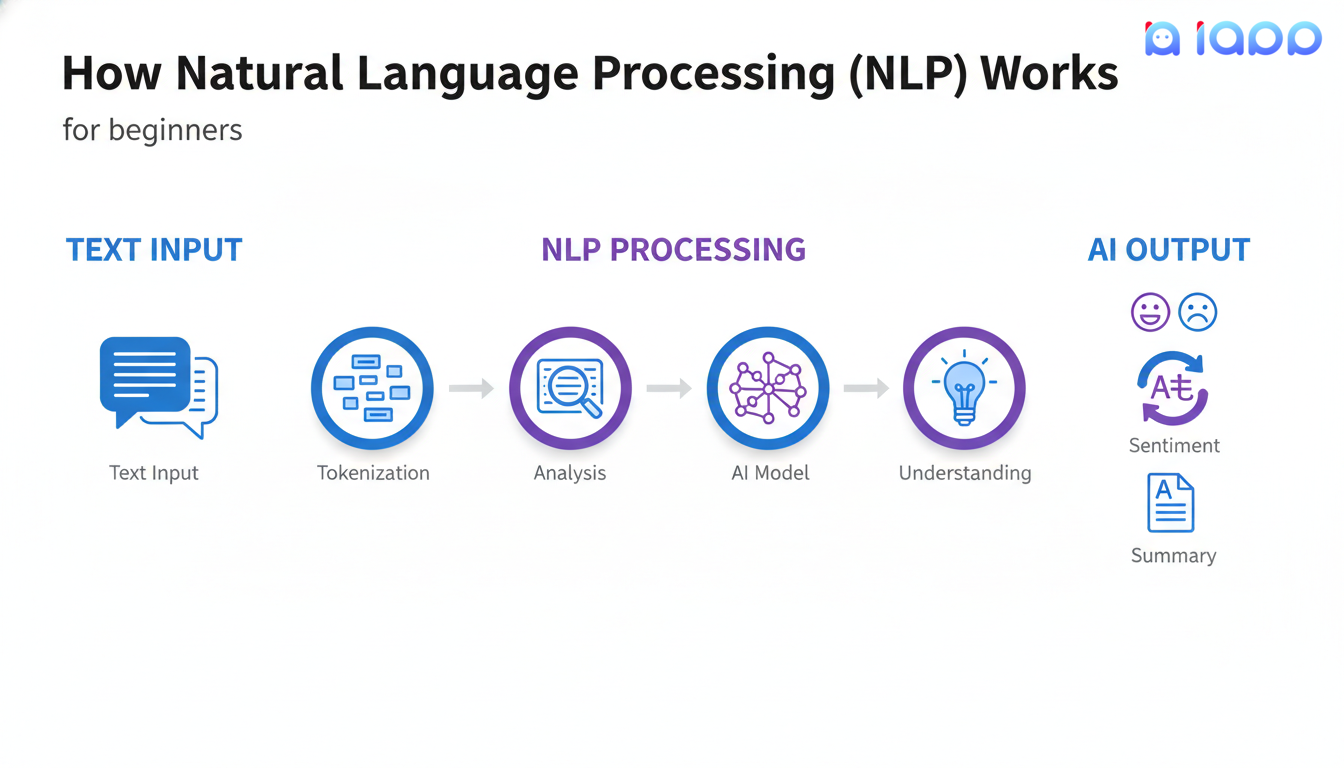
What is Natural Language Processing (NLP)?
Natural Language Processing (NLP) is a branch of artificial intelligence that enables computers to understand, interpret, and generate human language. It bridges the gap between human communication and computer understanding.
Simple Analogy
Imagine teaching a computer to read and understand Thai like a human does. When you read "วันนี้อากาศดีมาก" (The weather is very nice today), you instantly understand it's about weather and has a positive tone. NLP teaches computers to do the same thing - understand meaning, context, and even emotions in text.
What Makes Thai NLP Special?
Thai language presents unique challenges for NLP:
-
No Word Boundaries: Thai text has no spaces between words
- English: "I love Thailand"
- Thai: "ฉันรักประเทศไทย" (no spaces!)
-
Complex Script: 44 consonants, 32 vowels, 5 tones, and stacking characters
-
Context-Dependent Meaning: Same word can have different meanings based on context
-
Colloquial vs Formal: Significant differences between spoken and written Thai
-
Particles and Politeness: Words like "ครับ/ค่ะ" that don't translate directly
This is why specialized Thai NLP solutions like iApp's are essential for accurate processing.
5 Key Terms You Need to Know
Before diving deeper, let's clarify some NLP jargon that often confuses beginners:
1. Tokenization (Word Segmentation)
Tokenization is the process of breaking text into smaller units called tokens. For English, it's simple - words are separated by spaces. For Thai, it's complex because there are no spaces!
English:
Input:  "I love Thailand"
Output: ["I", "love", "Thailand"]
Thai:
Input:  "ฉันรักประเทศไทย"
Output: ["ฉัน", "รัก", "ประเทศไทย"]
Why it matters: Tokenization is the foundation of all NLP tasks. Without proper word segmentation, Thai NLP cannot work correctly.
2. Sentiment Analysis
Sentiment Analysis determines the emotional tone of text - positive, negative, or neutral.
| Input Text | Sentiment | Score |
|---|---|---|
| "สินค้าดีมาก ชอบมาก" (Great product, love it) | Positive | 0.95 |
| "บริการแย่มาก" (Terrible service) | Negative | 0.89 |
| "ร้านเปิด 9 โมง" (Shop opens at 9) | Neutral | 0.72 |
Why it matters: Businesses use sentiment analysis to automatically understand customer feedback from thousands of reviews.
3. Named Entity Recognition (NER)
Named Entity Recognition identifies and classifies named entities in text into categories like person names, organizations, locations, dates, etc.
Input: "นายสมชาย ทำงานที่ บริษัท ไอแอพ ในกรุงเทพฯ"
Output:
- "นายสมชาย" → PERSON
- "บริษัท ไอแอพ" → ORGANIZATION
- "กรุงเทพฯ" → LOCATION
Why it matters: NER helps extract structured information from unstructured text, essential for data mining and information retrieval.
4. Part-of-Speech (POS) Tagging
Part-of-Speech Tagging labels each word with its grammatical category (noun, verb, adjective, etc.).
Input: "แมว กิน ปลา"
Output:
- "แมว" (cat) → NOUN
- "กิน" (eat) → VERB
- "ปลา" (fish) → NOUN
Why it matters: POS tagging helps NLP systems understand sentence structure and word relationships.
5. Text Embedding
Text Embedding converts text into numerical vectors that capture semantic meaning. Similar meanings result in similar vectors.
"สุนัข" (dog)  → [0.2, 0.8, 0.1, ...]
"หมา" (dog)    → [0.21, 0.79, 0.11, ...]  // Similar!
"รถยนต์" (car) → [0.7, 0.1, 0.5, ...]     // Different
Why it matters: Embeddings enable semantic search, finding content by meaning rather than exact keyword matching.
Why is Thai NLP Important?
1. Digital Thailand Initiative
Thailand is rapidly digitizing government and business services. NLP enables:
- Automated document processing
- Intelligent customer service
- Smart search engines for Thai content
2. Business Intelligence
Understanding customer feedback at scale:
- Analyze thousands of reviews in seconds
- Track brand sentiment on social media
- Identify trending topics and concerns
3. Breaking Language Barriers
NLP-powered translation and communication:
- Real-time Thai-English translation
- Multilingual customer support
- Cross-border business communication
4. Accessibility
Making technology accessible to all Thai speakers:
- Voice assistants that understand Thai
- Text-to-speech for visually impaired
- Automatic subtitles for Thai content
What Problems Does Thai NLP Solve?
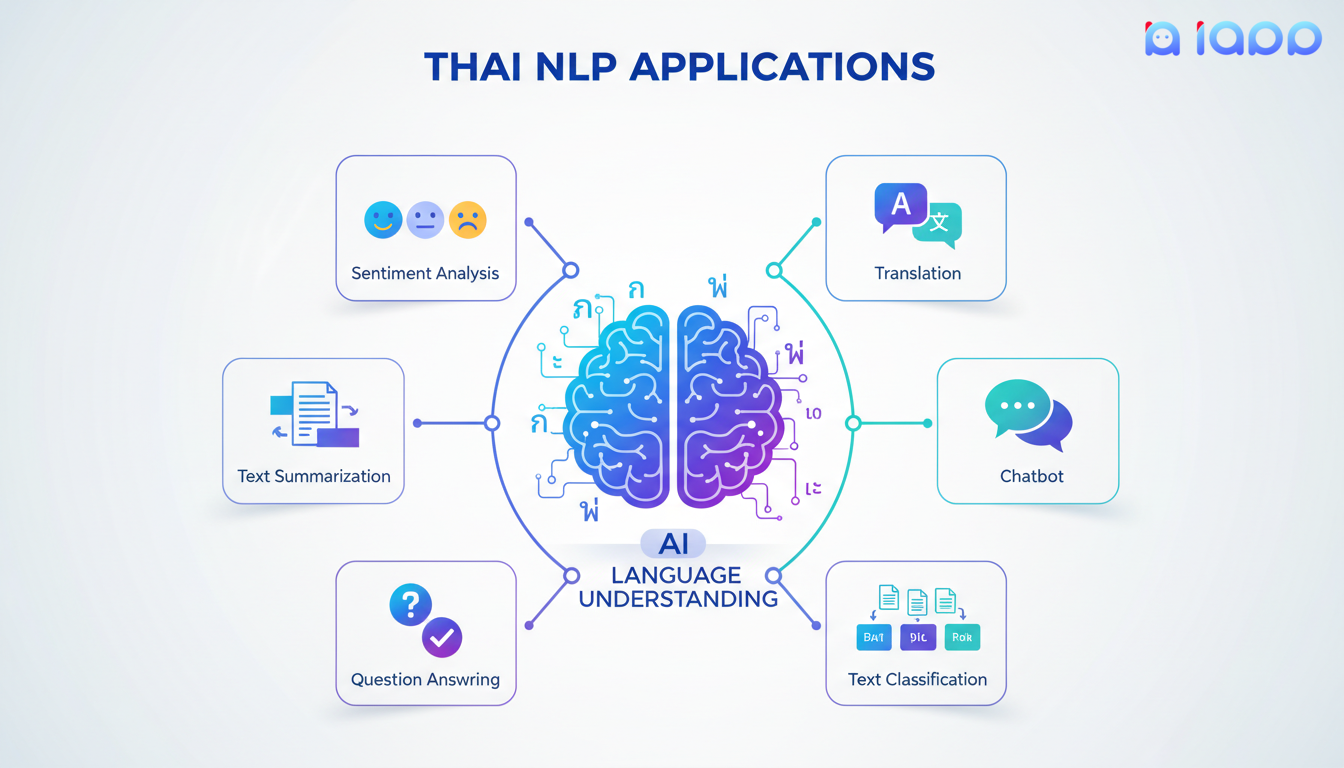
Sentiment Analysis
- Customer Feedback: Automatically classify reviews as positive/negative
- Social Media Monitoring: Track brand sentiment in real-time
- Market Research: Understand public opinion on products/services
Translation
- Business Communication: Translate documents between Thai and 27+ languages
- E-commerce: Localize product descriptions for Thai market
- Tourism: Provide multilingual information services
Text Summarization
- News Aggregation: Summarize long articles into key points
- Document Review: Quickly understand lengthy reports
- Meeting Notes: Generate concise summaries from transcripts
Chatbots & Virtual Assistants
- Customer Service: 24/7 automated support in Thai
- FAQ Automation: Instant answers to common questions
- Lead Generation: Qualify prospects through conversation
Question Answering
- Knowledge Base: Build intelligent FAQ systems
- Document Search: Find answers within large document collections
- Educational Tools: Create interactive learning experiences
Text Classification
- Email Routing: Automatically categorize support tickets
- Content Moderation: Detect inappropriate content
- Document Organization: Auto-tag and categorize documents
How Does Thai NLP Work?
Let's break down the NLP process step by step:
Step 1: Text Preprocessing
Raw text is cleaned and normalized:
- Remove special characters and formatting
- Convert to consistent encoding (UTF-8)
- Handle Thai-specific issues (tone marks, vowels)
Step 2: Tokenization (Word Segmentation)
Thai text is split into words using specialized algorithms:
- Dictionary-based methods
- Machine learning models
- Deep learning approaches (modern)
Step 3: Feature Extraction
Text is converted into numerical representations:
- Word embeddings (Word2Vec, FastText)
- Contextual embeddings (BERT, WangchanBERTa)
- Statistical features (TF-IDF)
Step 4: Model Processing
AI models analyze the features:
- Deep neural networks
- Transformer models
- Pre-trained language models
Step 5: Output Generation
Results are produced based on the task:
- Classification labels (sentiment, category)
- Generated text (summaries, translations)
- Extracted entities (names, locations)
How to Use Thai NLP
Method 1: Web Demo
Try iApp's NLP directly on our website - no coding required!
- Visit Sentiment Analysis Demo
- Enter Thai text
- See results instantly
Method 2: API Integration
For developers, integrate NLP via REST API:
import requests

# Thai Sentiment Analysis
url = "https://api.iapp.co.th/v3/store/nlp/sentiment-analysis"

headers = {"apikey": "YOUR_API_KEY"}
params = {"text": "สินค้าดีมาก คุณภาพเยี่ยม"}

response = requests.post(url, headers=headers, params=params)
result = response.json()

print(f"Sentiment: {result['label']}")  # pos, neg, or neu
print(f"Confidence: {result['score']}")  # 0.0 to 1.0
Method 3: Batch Processing
Process multiple texts efficiently:
# Batch Translation
url = "https://api.iapp.co.th/v1/text/batch_translate"

data = [
    {"text": "สวัสดี", "source_lang": "th", "target_lang": "en"},
    {"text": "ขอบคุณ", "source_lang": "th", "target_lang": "en"}
]

response = requests.post(url, headers=headers, json=data)
Thai NLP Examples
Example 1: Sentiment Analysis
Input: "อาหารอร่อยมาก บริการดี จะกลับมาอีกแน่นอน"
Output:
{
  "label": "pos",
  "score": 0.9234
}
Use Cases: Review analysis, social media monitoring, customer feedback
Example 2: Text Summarization
Input: (Long Thai news article - 500 words)
Output:
{
  "summary": "ตำรวจจับกุมผู้ต้องหา 1 ราย พร้อมยึดอาวุธปืน 2 กระบอก ในพื้นที่ จ.สงขลา...",
  "style": "standard"
}
Use Cases: News aggregation, document review, research summaries
Example 3: Translation
Input:
{
  "text": "ยินดีต้อนรับสู่ประเทศไทย",
  "source_lang": "th",
  "target_lang": "en"
}
Output:
{
  "translation": "Welcome to Thailand",
  "processing_time": 0.056
}
Use Cases: Content localization, business communication, tourism
Example 4: Question Answering
Input:
{
  "context": "บริษัท ไอแอพ เทคโนโลยี จำกัด ก่อตั้งเมื่อปี 2560 ให้บริการ AI API...",
  "question": "บริษัทก่อตั้งเมื่อไหร่"
}
Output:
{
  "answer": "ปี 2560",
  "confidence": 0.95
}
Use Cases: FAQ systems, document search, customer support
iApp Technology's Thai NLP Services
At iApp Technology, we offer comprehensive NLP solutions for Thai language:
Thai Sentiment Analysis
- Classification: Positive, Negative, Neutral
- Accuracy: High precision with confidence scores
- Cost: 1 IC per 400 characters
- Try Demo
Multilingual Translation
- Languages: 28 languages including Thai, English, Chinese, Japanese
- Quality: BERTScore above 0.85 for all language pairs
- Speed: 18 seconds per 100 sentences (batch mode)
- Try Demo
Thai Text Summarization
- Styles: Standard, Clarify, Friendly
- Languages: Thai and English
- Batch Support: Process multiple documents at once
- Try Demo
Question Answering
- Context-based: Extract answers from documents
- Thai Support: Native Thai language understanding
- Try Demo
Toxicity Classification
- Detection: Identify toxic, offensive content
- Moderation: Automated content filtering
- Try Demo
Getting Started with iApp NLP APIs
Step 1: Create a Free Account
Visit iapp.co.th/register to create your account.
Step 2: Get Your API Key
Go to API Key Management to generate your key.
Step 3: Choose Your NLP Service
Select the NLP task you need from our documentation.
Step 4: Make Your First API Call
# Sentiment Analysis
curl -X POST "https://api.iapp.co.th/sentimental-analysis/predict?text=สินค้าดีมาก" \
  -H "apikey: YOUR_API_KEY"
Step 5: Integrate and Scale
Use our code examples in Python, JavaScript, PHP, Swift, Kotlin, Java, and Dart.
Best Practices for Thai NLP
Data Quality Tips
- Clean Text: Remove unnecessary formatting and special characters
- Consistent Encoding: Always use UTF-8 for Thai text
- Proper Segmentation: Verify word boundaries for accurate analysis
- Context Preservation: Keep enough context for accurate sentiment/meaning
Integration Tips
- Handle Errors: Implement proper error handling for API calls
- Rate Limiting: Respect API rate limits for stable performance
- Batch Processing: Use batch endpoints for bulk operations
- Caching: Cache results for repeated queries
Thai-Specific Tips
- Colloquial Language: Consider informal Thai text variations
- Regional Dialects: Be aware of regional language differences
- Code-Switching: Handle Thai-English mixed text
- Particles: Account for Thai politeness particles
Summary
Thai Natural Language Processing enables computers to understand and process Thai language. Here's what we covered:
- NLP enables computers to understand, interpret, and generate human language
- Key terms: Tokenization, Sentiment Analysis, NER, POS Tagging, Text Embedding
- Thai challenges: No word boundaries, complex script, context-dependent meaning
- Applications: Sentiment analysis, translation, summarization, chatbots, Q&A
- iApp solutions: Sentiment Analysis, Translation (28 languages), Summarization, Q&A
The ability to process Thai language at scale opens new possibilities for businesses and developers in Thailand.
Ready to Try Thai NLP?
Start leveraging the power of Natural Language Processing today:
- Create Free Account - Get started in minutes
- Try Sentiment Analysis - Analyze Thai text sentiment
- Try Translation - Translate between 28 languages
- Explore All NLP APIs - Full documentation
- Contact Us - Enterprise solutions
Have questions? Join our Discord community or email us at support@iapp.co.th.
iApp Technology Co., Ltd. Thailand's Leading AI Company